
Electronic monitoring data requirements: what to collect, why it matters, and what AI changes
In brief
- EM requirements should start from management questions, not camera specifications.
- Video, sensor and review metadata must be synchronised into event-level evidence with provenance.
- Computer vision can reduce review cost, but sampling design is what determines whether the resulting evidence is trustworthy.
NOAA defines electronic monitoring (EM) broadly: video cameras, GPS, transmitters, gear sensors and automated image processing can be combined to capture fishing location, activity, catch, discards and protected-species interactions (NOAA Fisheries). That definition is useful because it prevents EM from being reduced to “put a camera on a boat.” The data requirement is determined by the decision requirement.
Start with the question
Different objectives need different evidence:
A camera layout, frame rate or retention policy should be justified against those objectives.
Minimum synchronised data
Each sensor stream requires a common clock and immutable identifiers:
- vessel and trip ID;
- device/camera/sensor ID and firmware/configuration;
- UTC timestamps with drift/health checks;
- video/image segment URI plus integrity hash;
- GPS/VMS/AIS position where legally/operationally appropriate;
- gear/activity sensor events;
- event start/end and event type;
- machine output: model/version, label, confidence/uncertainty;
- review output: reviewer/version, correction, disposition;
- retention/access classification.
The objective is not to maximise schema size, but to ensure that every reported claim can be traced to its source evidence, processing version and review history.
Review design is part of the data design
The largest recurring costs in EM programmes include manual video review, transmission and storage. NOAA explicitly identifies computer vision and machine learning as potential ways to reduce those costs while extracting species, weight/length, gear counts and activity.
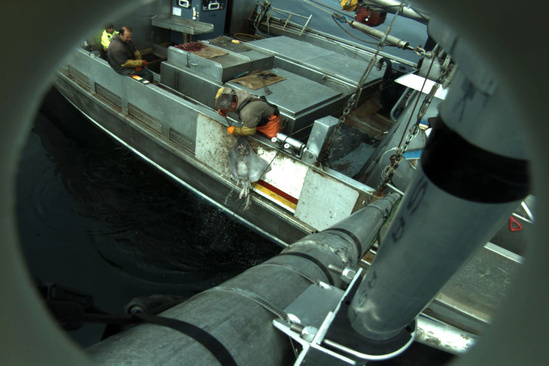
But a model that filters 95% of video also changes the statistical sample seen by humans. That means the review policy must contain a random audit stream in addition to AI-prioritised review. Otherwise the programme may become very efficient at reviewing what the model already knows how to find. The fisheries EM literature makes the same point from a programme design perspective: coverage allocation across vessels, space and time is fundamental to information quality, and optimisation of review must preserve the monitoring objective (Pierre et al., 2024).
What deep learning changes
Deep learning shifts EM from “record then manually watch” toward detect → aggregate → prioritise → verify.
The model stack usually includes:
- object detection / segmentation for catch and gear followed by species identification;
- tracking to connect repeated views of the same object to form an event;
- temporal models to aggregate detections into interaction events;
- representation learning for species similarity and domain shift;
- calibrated uncertainty to decide what requires human review.
The hard problem is generalisation across different cameras, vessels, decks, weather, catch handling and species mix all change (Yan et al., 2026). A deployment claim should therefore include vessel-held-out and temporal evaluation, not only random frame splits.
Governance and retention are requirements, not afterthoughts
EM produces sensitive operational imagery. NOAA has published specific policy on EM record retention and information law; federal EM imagery has a five-year records schedule when it becomes a federal record, and confidentiality/FOIA handling is explicitly addressed (NOAA Fisheries). Other jurisdictions will differ, but the system should treat retention class, access control and deletion date as data fields.
For standards-driven fisheries, MSC’s Evidence Requirements Framework focuses on information quality and how evidence is collected, reported, handled and analysed (MSC ERF, 2026). In October 2026 the framework is under active revision, including proposed changes to independent-observation expectations, so product requirements should be versioned against the applicable standard rather than hard-coded around a single coverage percentage.
Impact metrics: tuning to the decision question
Evaluating an EM model with an aggregate $F_1$ score ignores the asymmetric costs of errors in fisheries management. Model evaluation metrics must be explicitly tied to the questions defined above:
Tying these requirements back to the two primary reporting axes gives a balanced framework:
Monitoring quality
- Event recall by risk tier: near-complete recall on rare ETP interactions; balanced precision and recall on target species accounting.
- Unflagged-event audit recall: rigorous sampling of footage dropped by the filter to quantify what the model missed.
- False-alert burden: ensuring human reviewer time is spent verifying true anomalies rather than clearing pipeline noise.
- Inter-reviewer agreement & calibration: consistency between machine proposals and human expert dispositions.
- Evidence completeness: verifiable sensor coverage and timestamp synchronisation across vessels, trips and seasons.
Operational efficiency
- Review minutes per hour of footage: the net reduction in manual video review time achieved without compromising audit recall.
- Time from landing to validated record: speed of submitting final compliance-ready and certified data to management authorities.
- Bandwidth and storage per trip: compression achieved via on-edge triage without loss of critical evidentiary clips.
- Reviewer corrections per machine-flagged event: tracking domain drift and identifying systematic model blind spots.
- Hardware uptime and data availability: camera and sensor operational reliability under real offshore conditions.
The claim that matters is not “AI processed X hours of video.” An ideal scenario is that for a defined monitoring objective, the system produces an equally or more reliable evidence set with lower cost or latency, while explicitly quantifying what was still missed.
References and white papers
- NOAA Fisheries. Electronic Monitoring: Programmes, Policy, Retention, and Machine Learning Direction.
- NOAA Fisheries. Electronic Technologies for Fisheries Information.
- Pierre, J. P., Dunn, A., Snedeker, A., Wealti, M., Cozza, A. and Carovano, K. (2024). Optimising the review of electronic monitoring information for management of commercial fisheries. Reviews in Fish Biology and Fisheries, 34, 1707–1732.
- Yan, B., Ding, P., Zhu, J. and Wu, F. (2026). Research progress on electronic monitoring in tuna longline fisheries. Frontiers in Marine Science, 13, 1830102.
- Marine Stewardship Council (2026). Evidence Requirements Framework Revisions.