
Fish detection is not enough: evidence for ETP interactions
In brief
- Rare ETP interactions are an event-detection and evidence problem.
- Audit footage that the model did not flag is essential for estimating missed events.
- Standards change; map product evidence to versioned requirements rather than claiming certification.
For common catch, an AI classifier may still be useful with imperfect fine-grained labels. For endangered, threatened and protected (ETP) interactions, a false negative can carry disproportionate management significance.
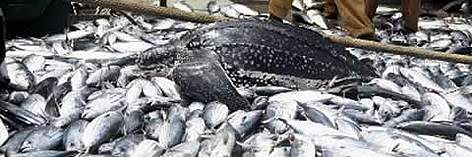
The modelling unit is an interaction
A single animal can appear in hundreds of frames. An ideal architecture separates:
frame representation → track/object → interaction event → reviewed evidence record.
Deep learning handles the first two layers: detection/segmentation, tracking and representation learning. Temporal logic or sequence models reconstruct the event and the final layer adds provenance, review and policy context (Yan et al., 2026).
For rare species taxonomy and low-frequency classes, hierarchical classification is useful: if species-level evidence is weak, a calibrated family/genus label plus “requires review” is more defensible than a confident forced prediction.
ETP evidence and MSC
MSC’s Version 3.1 system (Marine Stewardship Council, 2026) uses the Evidence Requirements Framework (MSC ERF, 2026) to evaluate information used in fishery assessment. In October 2026 the framework and ETP/out-of-scope requirements (MSC ETP, 2026) are under revision. Proposed changes emphasise objectivity, relevance, completeness and consistency of evidence, and move some independent-monitoring expectations into the Standard itself.
That means software should expose:
- coverage by trip/operation;
- source and independence of observation;
- chain of custody for images/video and corrections;
- missing-data/coverage flags;
- policy/standard version used in an export.
These are evidence-supporting capabilities, not a claim that the software certifies the fishery.
Impact
AI can make rare event monitoring more searchable and scalable, but the impact claim must connect to the management question. Useful metrics include time-to-review, independently verified coverage, missed-event rate, data completeness and the speed with which managers can investigate an interaction.
The responsible-AI principle is selective automation: automate common, well-calibrated cases; escalate uncertainty and high-consequence events.
References and standards
- Marine Stewardship Council (2022/2026). MSC Fisheries Standard Version 3.1.
- Marine Stewardship Council (2026). Evidence Requirements Framework Revisions.
- Marine Stewardship Council (2026). ETP and Out-of-Scope Species Requirements Revisions.
- Yan, B., Ding, P., Zhu, J. and Wu, F. (2026). Research progress on electronic monitoring in tuna longline fisheries. Frontiers in Marine Science, 13, 1830102.