
From detector accuracy to reviewable fisheries evidence
In brief
- Electronic Monitoring (EM) video collection outpaces manual human review capacity.
- Meenu uses hierarchical AI (L0 detection → L1/L2 classification) to compress review time by ~80%.
- Transfer tested on external vessels across the Pacific, achieving 82.4% Top-1 precision across 34 categories.
Electronic Monitoring (EM) systems on commercial fishing vessels capture hundreds of hours of video per trip, but manual review, annotation, and verification remain slow and expensive (NOAA Fisheries). Regional Fisheries Management Organisations (RFMOs) and conservation partners face an operational constraint: the value of EM data is limited by the effort required to process it.
As part of the Global Ocean Innovation Challenge led by The Nature Conservancy (TNC) and Newlab (TNC and Newlab, 2024), Blurgs AI developed Meenu—an AI platform designed to transform raw vessel imagery into high-quality, reviewable fisheries intelligence.
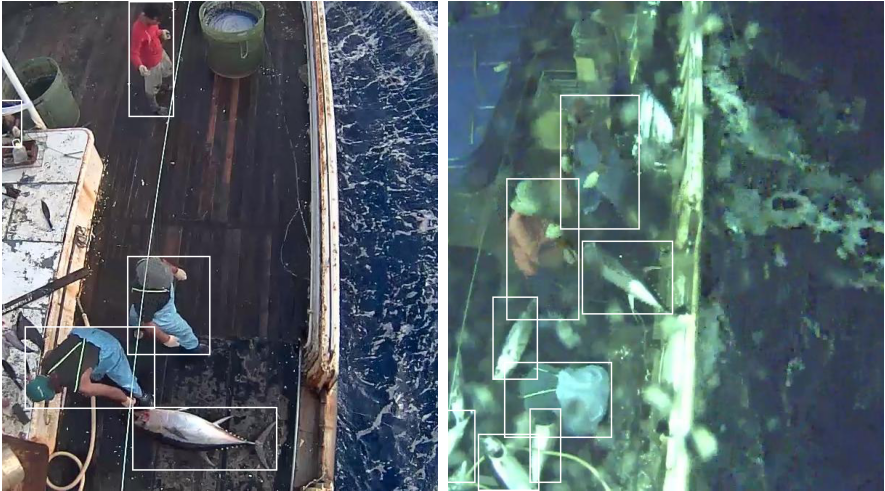
Hierarchical AI architecture
Open benchmarks like the Fishnet Open Images Database (144k images across 34 classes) provide valuable training data (Kay and Merrifield, 2021), but random frame splits mask severe operational shifts across vessel decks and camera setups. Rather than forcing fine-grained species classification on raw frames, Meenu structures EM video analysis hierarchically:
raw video → L0 catch detection → L1 family grouping → L2 species classification → human review.
- Level 0 (L0) - Catch Detection: Detects catch interactions on deck, filtering out thousands of hours of empty footage.
- Level 1 (L1) - Family Grouping: Identifies broad taxonomic families (e.g., tunas, billfish, sharks, rays, turtles).
- Level 2 (L2) - Granular Species Classification: Classifies fine-grained species (e.g., yellowfin vs. bigeye tuna, or protected ETP species).
On the FishNet benchmark, Meenu achieves 83.2% precision at L0, 78.2% at L1, and 78.0% at L2.
Cross-vessel generalisation
To test model transfer beyond the training distribution, Meenu was evaluated on unseen commercial longline footage across three external vessels (TNCVSL1, TNCVSL2, TNCVSL3) in two distinct operating environments.
Despite differences in deck layouts, camera angles, and illumination:
- Across all 34 categories, mean Top-1 precision reached 82.4% with 78.7% recall;
- In positive haul sequences, catch was detected in 7 of 8 video sequences;
These results demonstrate that broad L0 catch recognition and family-level features transfer effectively across ocean basins, while identifying where localized calibration is needed for fine-grained species and taxonomic classes.
Compressing human review by ~80%
AI predictions in fisheries cannot be treated as unexamined final observations. Meenu uses a structured human-in-the-loop workflow that reduces human review effort by approximately 80%, aligning with empirical review-optimization strategies (Pierre et al., 2024):
- Automated triage: Bypasses non-hauling periods and empty decks, indexing footage directly to candidate catch sequences.
- Priority queue: Routes high-uncertainty detections, rare classes, and potential ETP interactions to fisheries experts.
- Random audit queue: Samples unflagged footage to quantify false negatives, lens fouling, and drift.
- Verifiable provenance: Preserves the complete evidence chain—source frames, bounding boxes, model confidence, and reviewer edits.
References and sources
- The Nature Conservancy and Newlab (2024). Global Ocean Innovation Challenge: Tech Pilots Selected.
- Kay, M. and Merrifield, M. (2021). Fishnet Open Images Database: A Large-scale Dataset for Fish Detection and Identification. arXiv:2106.09178.
- NOAA Fisheries. Electronic Monitoring in U.S. Fisheries.
- Pierre, J. P., Dunn, A., Snedeker, A., Wealti, M., Cozza, A. and Carovano, K. (2024). Optimising the review of electronic monitoring information for management of commercial fisheries. Reviews in Fish Biology and Fisheries, 34, 1707–1732.